Moving Beyond the Limits of Venue Sustainability
While venue sustainability is vital, delegate travel typically accounts for 70 to 90% of an event's total carbon footprint. By adopting a "door-to-door" mindset, optimising event locations through data and prioritising regional hubs, organisers can significantly reduce these emissions while maintaining international reach and a high-quality attendee experience.
CARBON FOOTPRINTEVENTS
Mark Haley
11/27/20252 min read
Introduction: Why Delegate Travel Is the Real Sustainability Frontier
Walk into any modern conference venue today, and you will see the hallmarks of sustainable operations: LED lighting, solar panels, and zero-waste catering. These are genuine, hard-won achievements. However, an uncomfortable truth remains: even the world’s greenest venue can host an event with a massive carbon footprint if thousands of delegates travel long distances to attend.
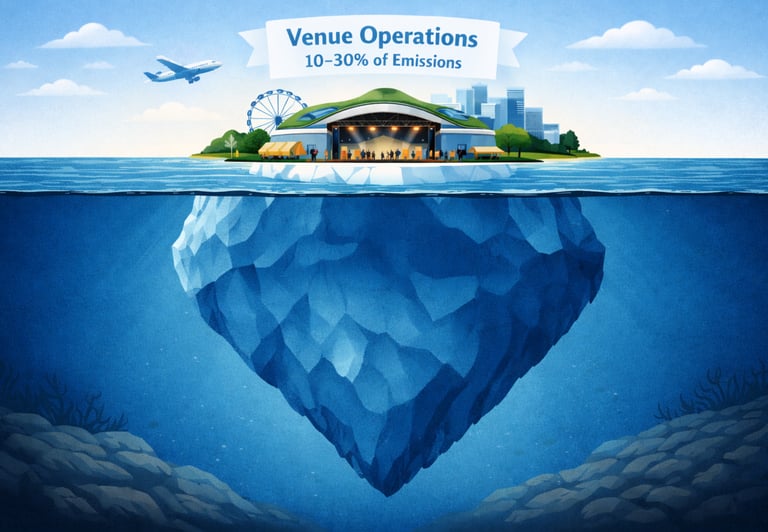
For most large events, delegate travel accounts for 70–90% of total emissions. While the industry has focused heavily on venue-based sustainability, these operational savings are often just the tip of the iceberg. The real environmental challenge, and the next frontier for our industry, lies outside the venue walls..
Why Venue Sustainability Alone Isn't Enough
Over the last decade, we have made incredible progress in reducing venue footprints through renewable energy, water conservation, and eliminating single-use plastics. But these improvements often address only a fraction of the total impact.
Consider this: a single intercontinental return flight from New York to London generates approximately 986 kg of CO2e per passenger. When you multiply that by hundreds or thousands of attendees, those emissions quickly eclipse any operational reductions achieved on-site.
ICE London 2024 saw 58% international attendance, with air travel alone generating an estimated 35,000 tonnes of CO2e.
The "Door-to-Door" Mindset
At Bizumi, we advocate for a door-to-door sustainability mindset. This means considering the entire delegate journey from the moment they leave home until they return. A truly holistic strategy evaluates:
Primary Travel Mode: Evaluating air, rail, coach, and car options.
Last-Mile Connections: Utilising public transport and shuttle services.
Accommodation: Choosing stays based on proximity to the venue and eco-credentials.
On-Site Experience: Balancing energy use and sustainable catering.
Data from recent events proves that location is the most significant factor in emissions. For example, ICE London 2024 saw 58% international attendance, with air travel alone generating an estimated 35,000 tonnes of CO2e. Conversely, events like Automatica Munich benefited from a higher proportion of regional attendees who could utilise lower-carbon rail and road travel.
A Strategic Framework for the Travel Frontier
Tackling travel emissions is often overlooked because it feels beyond an organiser's control. However, through smart planning and data, influence is possible. We recommend a six-step framework:
Start With Data
Capture origin data and intended travel modes at registration to model emissions scenarios.Optimise Event Location
Use multi-origin analysis to select venues that minimise total travel distance.Make the Green Choice Easy
Integrate rail and coach options into booking platforms, highlighting time and cost advantages.Influence Before Commitment
Use carbon calculators during registration to show personal emissions comparisons.Adopt Hybrid and Hub Models
Reduce long-haul travel by creating regional hubs connected by high-quality streaming.Measure and Report Transparently
Publish verified travel data in post-event reports to track year-on-year progress..
The Bizumi Perspective: Whole-System Thinking
The name Bizumi represents Business, You, and Me, signifying equality through a holistic, sustainable platform. This B-Corp-aligned philosophy demands that we look at the entire system of impact.
By applying whole-system thinking, we balance:
People: Making travel safer, more accessible, and less stressful.
Planet: Tackling the largest source of emissions head-on.
Profit: Helping organisers stand out to sponsors and delegates who value authentic sustainability.
In practice, this approach works. By using travel modelling and regional hubs, a large-scale international conference can maintain its global reach while cutting travel emissions by over 20%, all without harming the delegate experience..
The Future is Door-to-Door
Net zero venues are a milestone, not the finish line. The future of sustainable events lies in planning that starts at the delegate’s front door. Bizumi was built to provide the tools to measure, influence, and optimise this journey at every stage.
If you’re ready to move beyond operational wins and tackle the real sustainability frontier, let’s make it happen.